



How to Design Effective Incentive Plans for Insurance Agency CSRs and Account Managers
Recent Posts




When I speak with agency owners about their service teams, the scenarios are usually consistent: CSRs and account managers are stretched thin, but the agency hasn’t done a great job at truly defining their job. Agencies scale when service and sales roles are properly aligned but most incentive plans miss the mark by focusing on the wrong activities.
The key is designing incentive plans around service responsibilities, supported by clear expectations and measurable data.
The reason many agencies don’t use a service role based incentive program is because they don’t maintain quality data around service standards.
Key Points:
- Incentive plans for CSRs and account managers should reflect the service role specifically.
- Task management, data integrity, and service timelines are things many agencies can measure.
- Milestones help service employees see how their daily work contributes to agency success.
- Incentives should align with the agency’s client experience and service standards.
- Plans must be easy to track and administer to maintain team trust.
1. Clearly Define the Service Role
The first step in designing an effective incentive plan for CSRs and account managers is getting clear on what the role is actually responsible for and what it is not.
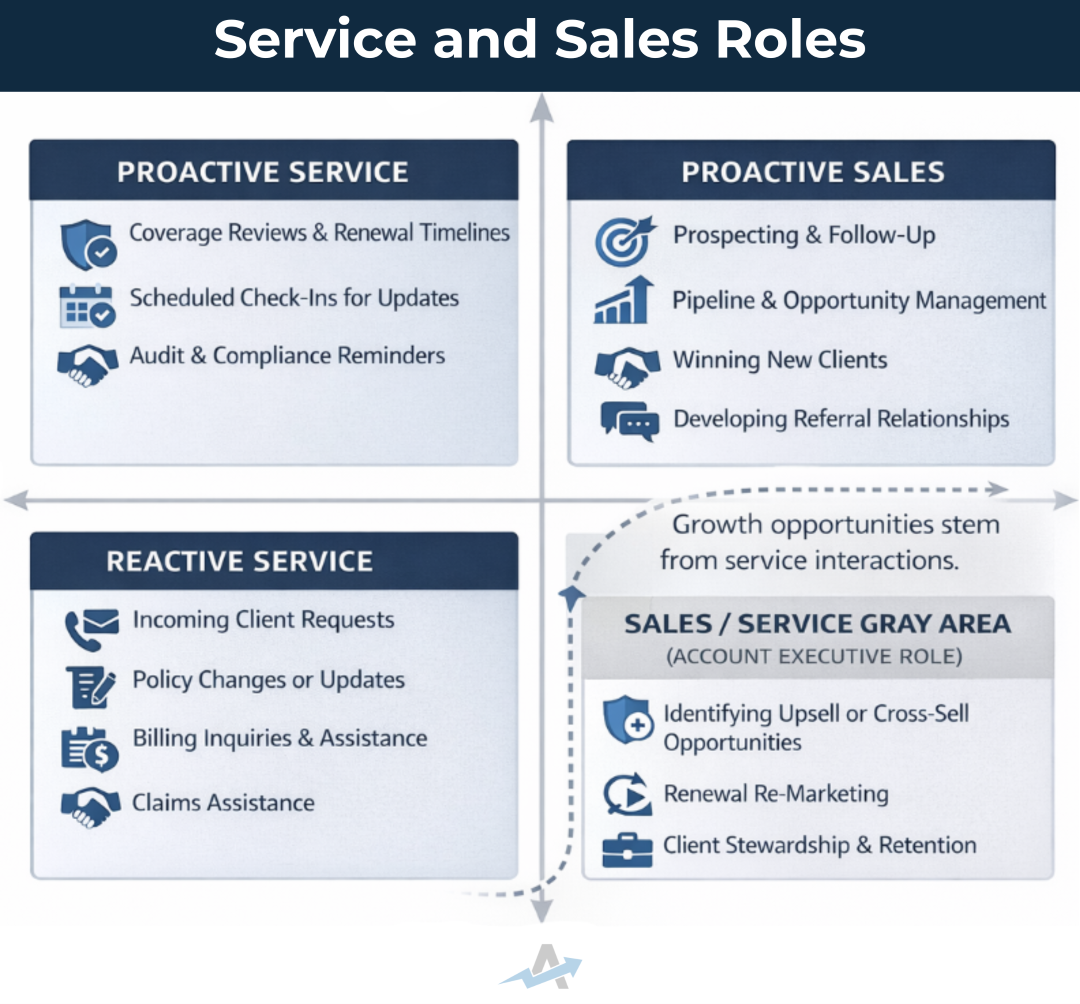
In many agencies, service staff roles blur the line between retention specialist, processor, receptionist, and occasionally producer. While some overlap is due to collaboration, unclear role boundaries make it difficult to design meaningful incentives.
There is ambiguity in many agencies also about what title is appropriate for service roles, but in general I would recommend:
CSR often means Customer Service Rep or Client Service Rep, and may be associated with more reactive client service tasks like processing change requests, assisting with billing inquiries, or basic service requests from clients.
Account Manager often refers to someone who may be more involved in proactive client service like renewal processing, more technical policy questions, and ensuring good client experience to increase retention.
In most agencies these roles are one in the same until an agency or team is large enough, and has enough service needs, to potentially segment these roles. But in general when considering incentives, the common core responsibilities of a CSR or account manager typically include:
- Client retention – managing renewals, policy reviews, and proactive outreach to keep clients engaged.
- Service delivery – processing changes, answering policy questions, and resolving issues efficiently.
- Data integrity – maintaining accurate client records, policy information, and activity notes in the AMS or CRM.
- POTENTIALLY Cross-sell and account rounding – identifying coverage gaps and recommending policies or assisting producers on existing clients.
Once the role is clearly scoped, incentives can be built around the activities that matter most to that position.
Example of keeping it relevant:
One of the most common challenges I see is service staff being held accountable for client retention and new business goals. That misalignment breeds frustration quickly and confusion on what should be prioritized. If someone’s upside compensation is weighted more to new business at the expense of providing better stewardship to existing clients . . . be prepared for one to fall short once that person is at capacity.
2. Establish Clear Service Expectations
CSRs and account managers should be able to clearly explain how their incentive plan works to themselves and to others. Every incentive plan should answer a few basic questions:
- What results are being measured?
- How are those results calculated?
- What time period applies?
- How is the incentive paid?
If a plan is too complicated to explain in a few sentences, it won’t get buy-in from the service team.
For service staff specifically, clarity around what counts is especially important. What type of retention is being used? Client count? Policy count? Premium retention? How are task completions being measured? What data fields are required to be completed?
Transparent reporting also builds the trust necessary for incentives to work. Service employees are more motivated when they can see their results in real time, understand how they are trending, and feel confident the numbers are accurate.
If possible, make a simple dashboard available to them at relevant time intervals, with proactive communications from their supervisor on status. Awareness helps with compliance for most.
3. Set Measurable Service Milestones
For CSRs and account managers, milestones should connect daily service activity to meaningful outcomes. Examples of measurable milestones for the service role include:
- Retention rate – tracking the percentage of accounts renewed within a book or team
- Renewal timelines – completing outreach to gather updates or review contacts within a set window before expiration
- Response time or service turnaround – meeting defined benchmarks for client-facing tasks
- Data integrity – maintaining accurate and current client information in the AMS
- Reputation management – requesting social media reviews, client testimonials, or receiving feedback on client surveys
This is also where having reliable agency data matters. Understanding your current retention baseline and service benchmarks allows you to set realistic base incentive thresholds as well as stretch goals that motivate without feeling unattainable.
4. Align Incentives with Agency Service Strategy
Incentives for your service team should reflect where the agency is focused strategically – not just what is easiest to measure. Strategy can evolve, so it can be an opportunity to utilize a base incentive plan tied to someone’s role and certain milestone based incentives for strategy related projects.
Each component should reflect what the individual CSR or account manager can directly influence. When service staff see a clear connection between their effort and their incentive outcome, engagement follows.
An example would be the service team’s base incentive is a scorecard program of task management, renewal timelines, and maintaining positive reviews from client surveys. Then the agency is also offering an educational incentive to earn one time bonuses for completing a skills or leadership development program being implemented for strategic planning.
5. Make Incentive Plans Easy to Administer
Even a well-designed incentive plan for your service team will break down if it’s difficult to manage consistently.
Agencies often rely on carrier reports or manually compiled spreadsheets to track incentives specifically tied to retention or premium goals, the data should ideally live in the AMS or another system the agency already uses to manage client activity. Most phone systems now integrate activity tracking with a CRM, or the AMS has built in renewal timeline management reports.
Effective incentive plans for CSRs and account managers should be:
- Easy to track using existing agency management systems.
- Simple to calculate without complex manual steps.
- Transparent so results are visible and not confusing.
- Consistently applied across the service team.
Simplicity builds trust and increases adoption.
Evaluate Your Agency’s Incentive Plan
One of the most overlooked opportunities in agency compensation is building a meaningful incentive structure specifically for CSRs and account managers. These roles are the backbone of an agency and a key part of what drives long-term agency value so giving them an ability to participate in the agency’s success can be a great tool to maintain engagement.
Even when best practices are followed, no plan will be perfect. Different service employees are motivated by different things. Some respond to individual performance metrics, others to team-based goals. Understanding what drives your specific team members is just as important as the structure of the plan itself.
If your agency has an incentive or compensation plan for your service team that you’d like to evaluate – or if you’ve never used one before and exploring your options – schedule a free consult so we can discuss what options may work best for your team.
Want a One-Page Summary?
If you want a one page summary of the two primary incentive plan structures used for service roles CLICK HERE.
Experts in Insurance Distribution Business Valuation, Sale, and Acquisition
We deliver superior results through our industry expertise, transaction expertise, and professional network.
Contact us